In today’s digital world, having a strong online presence is important for any business. Websites need to be easily found by search engines like Google to attract visitors. This is where SEO, or search engine optimization, comes into play. So, what is ongoing SEO?
Ongoing SEO is the continuous process of improving and maintaining a website’s performance in search engine results. It involves regular updates to content, optimizing keywords, and building links. This process helps the websites stay competitive, improve rankings and attract more visitors over time.
In this guide, we’ll explore ongoing SEO in detail. We’ll also discuss its key components and the benefits it provides.
Key Takeaways
- Continuous Optimization: Ongoing SEO requires regular updates to content, keywords, and technical elements to stay competitive.
- Maintaining Search Engine Rankings: Regular SEO efforts help websites stay visible and maintain high rankings on search engines like Google.
- Long-Term Organic Traffic Growth: Consistent SEO practices lead to increased and sustained organic traffic, boosting website visibility over time.
What Is Ongoing SEO?
Ongoing SEO is the continuous process of improving and updating a website’s search engine optimization. It focuses on maintaining and increasing a website’s ranking in search engine results. Search engines like Google use algorithms to decide which websites show up first. These algorithms change over time. Ongoing SEO makes sure a website keeps up with these changes. This can include updating keywords, adding new content, and fixing broken links.
Why Ongoing SEO Is Necessary?
Ongoing SEO is necessary because search engine rules change often. When a website is not updated, it can lose its ranking. This means fewer visitors. Regular SEO keeps the website up to date with these changes. It also helps a website stay ahead of its competition.
Websites that rank higher get more visitors, which can lead to more sales. For example, a website on page one of Google gets 10 times more traffic than one on page two. Without ongoing SEO, a website could lose this traffic.
Key Components Of Ongoing SEO
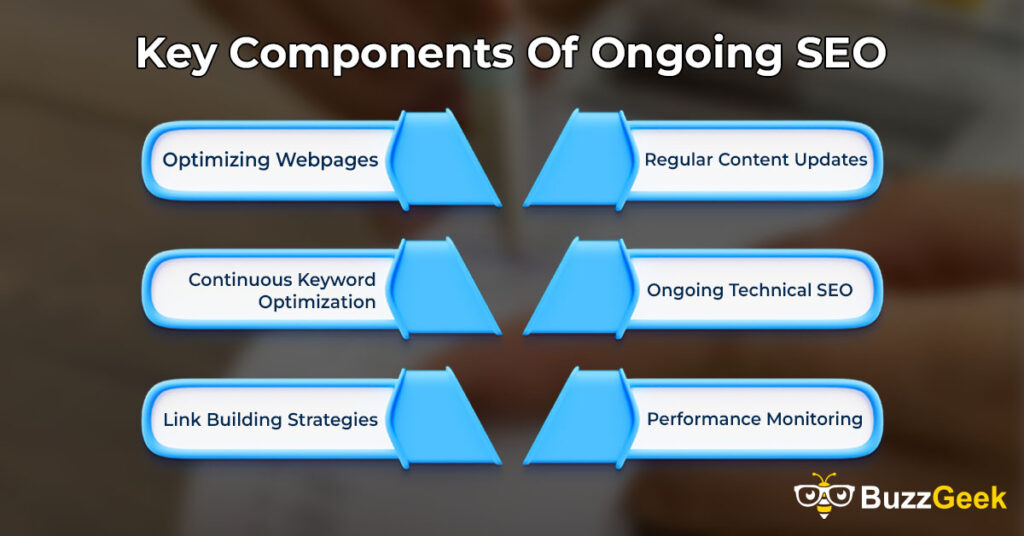
Ongoing SEO includes several important tasks. These tasks make sure a website stays optimized for search engines like Google. The main parts of ongoing SEO are optimizing webpages, updating content, checking keywords, fixing technical problems, building links, and monitoring website performance. Each part helps a website rank higher in search results.
Optimizing Webpages
Optimizing webpages means improving each page of a website so it can rank higher in search results. This involves making sure the page has the right keywords, clear headings, and easy-to-read content. It also includes using images with proper tags.
Optimized webpages load faster and provide a better user experience. For example, a page that loads in under 3 seconds can reduce the bounce rate by 50%. This helps the site rank better over time.
Regular Content Updates
Search engines prefer websites that are updated often. Adding new content or refreshing old content helps a site stay relevant. Regular updates can include blog posts, articles, or product descriptions.
For example, updating a blog with current information can increase traffic by 40%. This shows search engines that the site is active and provides fresh information. Regular updates also keep visitors interested, leading to more return visits.
Continuous Keyword Optimization
Keyword optimization is important for ongoing SEO. This means finding the right words that people search for and using them on your site. As search trends change, so do popular keywords. Regularly updating keywords keeps the site aligned with what users are searching for.
For example, changing keywords to match seasonal trends can boost website traffic during that time. Continuous keyword optimization helps ensure that a website ranks well for relevant searches.
Ongoing Technical SEO
Technical SEO focuses on the backend of a website. This includes fixing errors, improving site speed, and making sure the site is mobile-friendly. Search engines rank faster and error-free sites higher.
For example, a mobile-friendly site can have 50% more visitors than one that isn’t. Ongoing technical SEO helps a website stay in good health, making it easier for search engines to crawl and index the pages.
Link Building Strategies
Link building is the process of getting other websites to link to your site. The more high-quality links a site has, the better it will rank. This is because search engines see these links as a sign of trust.
For example, a website with 100 high-quality backlinks will rank higher than one with only 10. Ongoing link building is necessary because it helps keep a website’s authority strong over time.
Performance Monitoring
Monitoring a website’s performance is crucial for ongoing SEO. This includes checking how many visitors the site gets, which pages are most popular, and how well the site ranks for different keywords.
For example, tools like
Google Analytics can show that a website’s traffic increased by 20% after making certain changes. Regular performance checks help spot problems early and measure the success of ongoing SEO efforts. This allows for quick fixes and further optimization.
Implementing Ongoing SEO Strategies
To succeed in ongoing SEO, you need a clear plan. This plan helps make sure that SEO efforts are organized and effective. The plan should include setting goals, creating good content, and checking the website regularly. Each part of the strategy should work together to improve website performance. These actions will help maintain and improve search rankings.
Setting SEO Goals
Setting clear SEO goals is important. These goals help you know what to focus on. For example, a goal could be to increase organic traffic by 20% in six months. Setting goals gives direction to your SEO efforts and helps measure success.
It is important to set realistic and achievable goals. Without clear goals, it is hard to know if your SEO strategies are working. Tracking these goals helps you make adjustments when needed.
Prioritize Content Structure
Content structure is how information is organized on a webpage. It is important to make content easy to read and understand. Use headings, bullet points, and short paragraphs.
For example, a page with clear headings and subheadings is easier for users to read and search engines to understand. A good structure helps search engines index the content correctly. Prioritizing content structure improves user experience and can help improve rankings.
Keep Publishing
Publishing new content regularly is key to ongoing SEO. Fresh content keeps your website active and relevant. For example, posting a new blog or article each week can help drive traffic. Search engines prefer websites that publish often because they provide updated information.
Regular publishing also keeps visitors engaged, encouraging them to return to your site. A consistent content schedule can lead to more visibility over time.
Avoid Keyword Cannibalization
Keyword cannibalization happens when multiple pages on the same website target the same keyword. This can confuse search engines and hurt rankings. For example, if two blog posts target the same keyword, both may rank lower.
To avoid this, make sure each page targets unique keywords. Avoiding keyword cannibalization improves a site’s overall ranking. Each page should focus on different keywords to maximize SEO efforts.
Purge Content Occasionally
Purge old or outdated content from your website. This is important because search engines prefer fresh and accurate information. For example, if a blog post is no longer relevant, removing it can improve overall site quality.
Regularly purging old content ensures that only useful information remains on your site. This helps maintain a good ranking in search results. Removing outdated content also improves user experience by keeping the site clean and relevant.
Regular Site Audits
Regular site audits are important to catch problems early. A site audit checks the health of your website. For example, an audit can find broken links, slow pages, or other technical issues. These problems can lower your search ranking.
Audits help keep your website in top shape. They allow you to fix issues before they affect traffic. Conducting a site audit every few months helps maintain good SEO performance.
Make SEO Simple For Stakeholders
It is important to make SEO easy to understand for everyone involved. Stakeholders, such as business owners or managers, may not know much about SEO. Explaining the benefits and strategies in simple terms helps them support your efforts.
For example, use clear data to show how SEO increases website traffic. Keeping stakeholders informed makes it easier to get approval for ongoing SEO efforts. Simplicity helps ensure everyone works toward the same goal.
Competitor Analysis
Competitor analysis helps you see what others in your industry are doing. By studying your competitors, you can find new ways to improve your own SEO.
For example, if a competitor ranks higher for a keyword, analyze their content to see why.
This allows you to adjust your strategy to compete better. Regular competitor analysis helps you stay ahead in search rankings. It also helps identify areas where your website can improve.
Maintain Online Listings
Maintaining online listings is important for local SEO. These listings include Google My Business, Yelp, and other local directories. For example, keeping your business information up to date can help attract local customers.
Accurate listings improve visibility in local search results. Regularly updating these listings ensures that search engines have the correct information. This helps boost local rankings and increases website traffic.
Embrace EEAT
EEAT stands for Expertise, Experience, Authoritativeness, and Trustworthiness. These are important factors for search engines like Google. Websites that show these qualities rank higher.
For example, having expert authors write content can boost a site’s authority. Providing trustworthy information helps build credibility with both users and search engines. Embracing EEAT improves your site’s ranking and user trust. It also helps ensure that your website meets search engine standards.
Adaptation To Algorithm Changes
Search engine algorithms change regularly. It is important to keep up with these changes. For example, Google updates its algorithm many times a year. When your website doesn’t adapt, it could lose its ranking.
Monitoring these changes helps you adjust your SEO strategies. Staying updated on algorithm changes ensures your website continues to rank well. Adapting to these updates is essential for ongoing SEO success.
Benefits Of Ongoing SEO
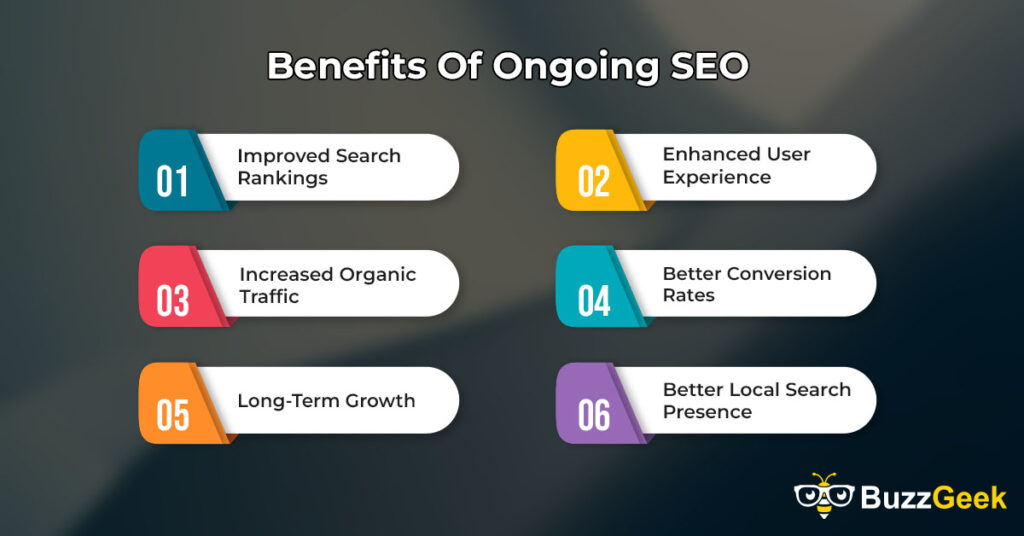
Ongoing SEO has many benefits for a website. These benefits help businesses grow and reach more people. Some key advantages include higher search rankings, better user experience, more traffic, and higher conversion rates. SEO work builds over time, leading to long-term success.
Improved Search Rankings
Ongoing SEO helps improve search rankings by keeping a website up to date. Search engines rank sites higher when they are optimized with the right keywords, content, and technical features.
For example, a website that updates its keywords regularly can see a 20% boost in rankings within a few months. Higher rankings mean more people will find the website. This can lead to more traffic and sales over time. Ongoing work is needed to stay on top.
Enhanced User Experience
SEO is not just about search engines; it also improves the experience for users. Faster websites, clear navigation, and mobile-friendly design all help users enjoy the site more. For example, a website that loads in 2 seconds or less can keep 50% more visitors than a slower one.
Good user experience also means visitors are more likely to return. Ongoing SEO ensures that a website stays easy to use and accessible for everyone.
Increased Organic Traffic
Organic traffic is the visitors who come to a website without paid ads. Ongoing SEO boosts organic traffic by improving search rankings and visibility. For example, a website that ranks on the first page of Google gets 90% of the traffic for that search term.
As a site improves its SEO, more people will find it through search engines. This results in steady growth in the number of visitors, leading to more potential customers.
Better Conversion Rates
SEO not only brings in more traffic but can also improve conversion rates. A well-optimized site makes it easier for users to find what they need. This can lead to more sales or sign-ups. For example, improving a site’s loading speed can increase conversions by 7%.
With ongoing SEO, a website continues to get better over time, making it easier for visitors to take action. This leads to higher revenue and more success.
Long-Term Growth
Ongoing SEO is a long-term strategy. It helps a website grow steadily over time. Unlike paid ads, which stop when the budget runs out, SEO keeps working.
For example, a business can see a 60% growth in traffic over a year by focusing on SEO. The results of ongoing SEO build up and provide lasting benefits. This makes it a smart investment for any website looking for long-term success.
Better Local Search Presence
For businesses with a local focus, ongoing SEO helps improve visibility in local search results. This is especially important for companies that rely on local customers. For example, optimizing for “near me” searches can increase traffic by 30%.
Ongoing SEO ensures that the website stays relevant for local searches, bringing in more customers from the surrounding area. This helps businesses grow their local presence and attract more foot traffic.
Challenges Of Ongoing SEO
Ongoing SEO has many benefits, but it also comes with challenges. These challenges can make it hard to keep up with the work needed to maintain high rankings. Some of the main challenges include the time it takes, staying updated on trends, keeping content quality high, and staying ahead of competitors. Each of these requires effort and planning.
Time And Resource Intensive
Ongoing SEO takes a lot of time and effort. It requires regular updates, research, and technical work. For example, a team may need to spend hours each week updating content, checking keywords, and fixing issues.
Small businesses with limited resources may find it difficult to keep up. SEO is not a one-time task, so this time commitment never really ends. Businesses need to dedicate time and resources consistently to see results.
Keeping Up With Trends
SEO trends and algorithms change often. Google updates its search algorithm many times a year. For example, in one year, Google may make 500 or more changes. These updates can affect how a website ranks.
Businesses need to stay informed about the latest SEO trends and make adjustments quickly. This requires constant learning and adapting. Falling behind on trends can hurt a website’s ranking and make it harder to recover.
Measuring ROI
Measuring the return on investment (ROI) from ongoing SEO can be difficult. SEO results take time to show, and it is not always easy to link improvements directly to specific SEO actions. For example, a business may see a traffic increase, but it may not know if that is because of SEO or other factors.
Since SEO is a long-term strategy, it may take months or even years to see significant returns. This makes it harder to calculate the immediate value of SEO efforts.
Managing Content Quality
Ongoing SEO requires constant content updates. However, managing the quality of that content can be a challenge. It’s not enough to simply add new content; it must be high quality and valuable to readers.
For example, adding low-quality content can hurt a website’s ranking. Ensuring that all new content is relevant, accurate, and engaging takes time and attention. Businesses must balance quantity with quality to avoid harming their SEO efforts.
Staying Ahead Of Competitors
Competition is a major challenge in SEO. Other websites are also working on their SEO, which makes it harder to stay on top. For example, if a competitor improves its SEO, it can outrank your website.
This requires businesses to constantly monitor competitors and update their own strategies. Staying ahead in the competitive world of SEO takes effort, and falling behind can lead to a drop in traffic and rankings.
Common Tools For Ongoing SEO Maintenance
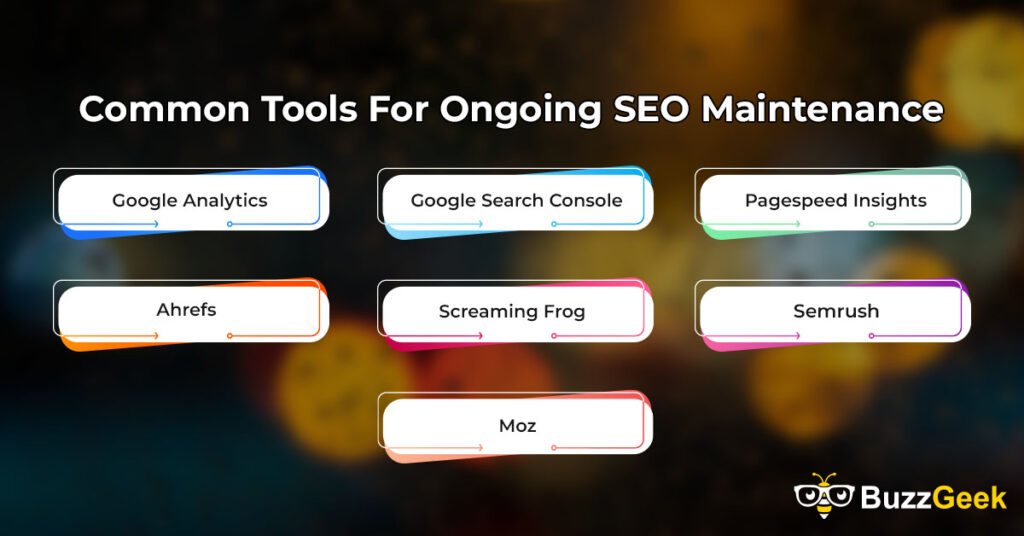
There are many tools available to help with ongoing SEO. These tools help track performance, find errors, and suggest improvements. Each tool has a specific purpose and helps in different areas of SEO. Using these tools makes it easier to keep a website updated and optimized.
For example, Google Analytics can track how many visitors a site gets and where they come from. Below are some common tools used in ongoing SEO maintenance that help websites stay competitive.
Google Analytics
Google Analytics is a free tool that tracks website traffic. It shows how many people visit your website, how long they stay, and what pages they view. This tool also shows where visitors come from, like search engines or social media.
For example, Google Analytics can show if a recent SEO change increased traffic by 20%. This tool is essential for monitoring website performance and understanding user behavior.
Google Search Console
Google Search Console helps website owners track their search rankings and find technical issues. It shows which keywords bring traffic and how a site appears in search results.
For example, it can alert you if Google has trouble indexing a page. It also shows which pages have the most clicks and impressions. This tool is important for fixing technical problems and improving SEO rankings.
Semrush
Semrush is an all-in-one SEO tool that helps with keyword research, competitor analysis, and tracking rankings. It shows which keywords a website ranks for and suggests new ones to target.
For example, Semrush can help find a keyword that competitors are using but you are not. It also tracks the performance of backlinks, which are important for ranking higher. Semrush provides detailed insights for improving a website’s SEO strategy.
Ahrefs
Ahrefs is a powerful tool for tracking backlinks and keyword rankings. It helps find which websites are linking to yours and shows how strong those links are. For example, Ahrefs can show if your website gained 50 new backlinks in the last month.
It also tracks keyword rankings over time and shows how well a website performs in search results. Ahrefs is widely used for improving a website’s link-building strategy.
Moz
Moz is another popular SEO tool that focuses on tracking rankings, keywords, and link building. It provides a “Domain Authority” score, which shows how well a website is likely to rank in search results.
For example, a higher Domain Authority can mean better search rankings. Moz also provides tools for keyword research and on-page optimization, helping websites improve their overall SEO performance.
Screaming Frog
Screaming Frog is a website crawler that scans websites for technical issues. It helps find problems like broken links, missing meta tags, and duplicate content. For example, if a site has 10 broken links, Screaming Frog will find and report them.
This tool is helpful for fixing technical SEO issues that could hurt a website’s ranking. It provides detailed reports on the health of a website, making it easier to maintain good SEO practices.
Pagespeed Insights
Pagespeed Insights is a tool from Google that measures how fast a website loads. It gives a score based on how quickly pages load on both mobile and desktop. For example, a page with a score above 90 is considered very fast.
Pagespeed Insights also provides suggestions for improving site speed, such as compressing images or enabling browser caching. Fast-loading websites rank higher in search results and provide a better user experience.
FAQs
Is Ongoing SEO Necessary For All Websites?
Yes, ongoing SEO is necessary for all websites. Search engine algorithms change often, and websites need to keep up to maintain or improve their search engine rankings. Even small businesses and personal websites benefit from continuous SEO because it helps them reach more people and stay visible online.
How Does Ongoing SEO Support Brand Authority?
Ongoing SEO helps build brand authority by improving a website’s visibility and credibility. When a website ranks high in search results, people see it as a trusted source of information. Regular updates, high-quality content and strong backlinks show search engines and users that the brand is reliable.
What Are The Risks Of Neglecting Ongoing SEO Efforts?
Neglecting ongoing SEO can lead to a drop in search rankings for your website. This leads to less traffic, fewer visitors, and missed opportunities. Search engines may also not index the website properly if technical issues are not fixed. Competitors who keep up with SEO can easily outrank the website.
Is Ongoing SEO Cost-Effective?
Yes, ongoing SEO is cost-effective in the long run. While it requires an investment of time and resources, it helps generate organic traffic without the need for paid ads. Improvements made through SEO can lead to higher search rankings, more visitors and better conversions, making it a smart investment.
How Long Does It Take To See Results From Ongoing SEO?
It usually takes several months to see noticeable results from ongoing SEO. Small improvements may appear in a few weeks, like fixing technical issues. However, major changes, such as higher rankings, can take 3 to 6 months or longer. SEO is a long-term strategy, and results grow with continuous effort.
Conclusion
Ongoing SEO is essential for any website that wants to stay competitive and attract more visitors. By regularly updating content, optimizing keywords, fixing technical issues, and building links, a website can maintain its search rankings and grow its organic traffic. SEO is not a one-time task but a continuous process that delivers long-term benefits. Staying consistent with SEO efforts helps ensure the success and visibility of a website over time.