In today’s digital world, reaching customers around the globe is easier than ever before. However, to truly connect with people in different regions, businesses need more than just a translated website. This is where SEO localization comes into play. So, what is SEO localization?
SEO localization means changing your website to fit a local market. It includes translating your content into the local language, using local search words and considering cultural differences. The goal is to help your website show up in local searches and bring in more visitors from that area.
In this guide, we’ll explore the key aspects of SEO localization. We’ll discuss its importance, the challenges you might face, and the best practices to follow.
Key Takeaways
- Content Adaptation: SEO localization changes your website content to match local markets.
- Keyword and Culture: It includes using local keywords and considering cultural differences.
- Improved Local Reach: The goal is to rank higher in local search results and attract more regional visitors.
What Is SEO Localization?
SEO localization means adapting your website for a specific local market. This involves translating your content into the local language and using local keywords. The main goal is to help your website rank better in local search results and attract more visitors from that area.
Why Is Having An SEO Localization Strategy Important?
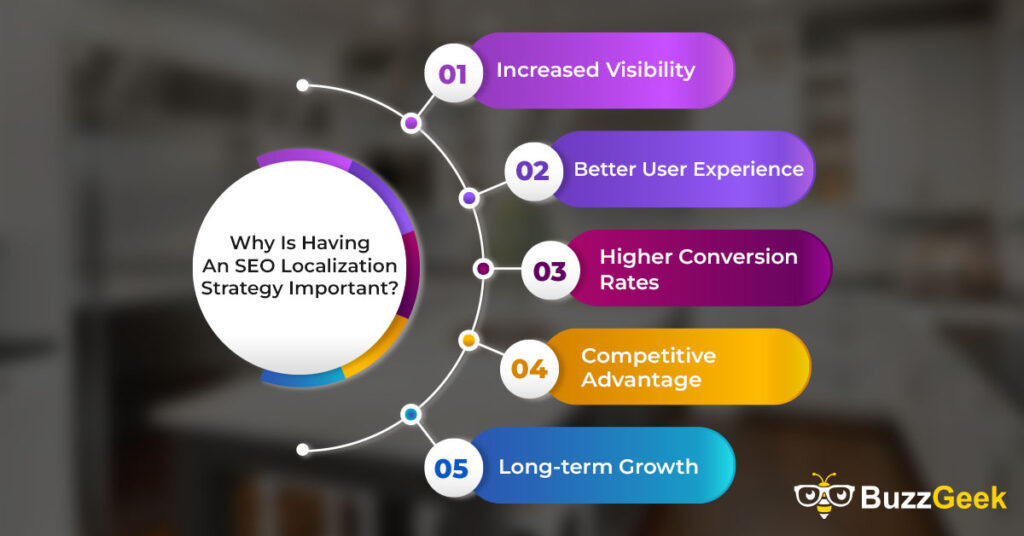
Having an SEO localization strategy is very important for any business that wants to reach more people. When you adjust your content to fit the language and culture of a specific area, it helps local users find your website. This makes your website show up more in local searches and creates a better experience for users, which can lead to more sales.
Here’s why SEO localization is important:
- Increased Visibility: Localized content ranks higher in local searches, making it easier for users to find your website.
- Better User Experience: When users see content in their own language and culture, they feel more comfortable and trust your brand.
- Higher Conversion Rates: Localized content connects better with users, leading to more sales.
- Competitive Advantage: Many businesses do not localize their content. Doing so helps you stand out and capture more of the market.
- Long-term Growth: A good SEO localization strategy helps your business grow in new markets over time.
Key Components Of SEO Localization
SEO localization involves several important steps. Each step helps make your website more appealing to local users. It also improves your chances of ranking higher in local search results. Below are the key components of SEO localization. Each of these plays a crucial role in ensuring that your website reaches the right audience in the right way.
Keyword Translation
Keyword translation is more than just changing words from one language to another. It involves finding the right words that local people use when they search online. For example, in the U.S., people might search for “apartment,” while in the U.K., they might use “flat.”
Using the correct keywords helps your website appear in local search results. This ensures that your content matches what local users are looking for.
Localized Content
Localized content means making content that matches the language, culture, and interests of your audience. It’s more than just translating words. It’s about making the content meaningful for local users.
For example, if you want to reach people in Japan, your content should include examples and stories that Japanese users understand. Localized content helps connect with the audience and makes it more likely they will become customers.
Cultural Adaptation
Cultural adaptation means changing your website content to match the local culture. This includes adjusting images, colors, and the tone of your message to fit the region.
For example, colors can have different meanings in different cultures. By making these changes, your content becomes more suitable and attractive to local users. This helps build trust and makes people more likely to engage with your website.
Geo-Targeting
Geo-targeting is the practice of delivering content based on the user’s geographic location. This helps in showing the right content to the right people. For example, if a user is in France, they should see your website in French.
Geo-targeting ensures that users get a personalized experience based on their location. This can improve user satisfaction and increase the likelihood of conversions.
Local Link Building
Local link building is the process of getting links to your website from other local websites. These links help improve your website’s authority and visibility in local search results.
For example, if your business is in Mexico, getting links from other Mexican websites can boost your local SEO. Local link building shows search engines that your website is relevant and trusted within the local community. This helps in ranking higher in local searches.
Implement SEO Localization
Implementing SEO localization is important to make sure your website works well in different regions. Each step in this process helps your website connect better with local users. It also improves how well your site performs in local search results. Below are the steps you should take to successfully implement SEO localization.
Do Local Keyword Research
Local keyword research is the first step in SEO localization. It means finding the right words that people in a specific area use when they search online. For example, people in Canada may use different words than people in Australia to search for the same product.
By finding and using these local keywords, your website can rank higher in local search results. This ensures that local users can find your site easily.
Adapt To Cultural Differences
Adapting to cultural differences means changing your content to fit the local culture. This includes using the right language, tone, and images that are appropriate for the local audience.
For example, humor that works in one country may not work in another. By adapting your content to the local culture, you can make it more relatable and engaging for the local users. This helps in building trust and improving user experience.
Use Hreflang Attributes
Hreflang attributes are special tags that help search engines know which language and region your content is for. This is important if your website has content in different languages.
For example, if your website has versions in English and Spanish, hreflang tags tell search engines which version to show in each region. Using hreflang attributes makes sure users see the right version of your site, which improves their experience.
Choose The Right URL Structure
Choosing the right URL structure is important for SEO localization. The URL structure helps search engines understand the location and language of your website. There are different ways to do this, like using subdomains, subdirectories, or country code top-level domains (ccTLDs).
For example, a ccTLD like “.fr” for France shows that your website is for French users. Choosing the right URL structure can help your website show up better in local search results.
Address Duplicate Content
Duplicate content can harm your website’s SEO. It occurs when the same content appears in more than one place on the internet. This can be a problem if you have multiple versions of your site for different regions.
To avoid this, make sure each version of your site has unique content or use canonical tags to tell search engines which version is the original. Addressing duplicate content helps improve your site’s ranking in search results.
Optimize For Different Search Engines
Not all countries use the same search engine. For example, Google is popular in many places, but in China, Baidu is the main search engine. Optimizing for different search engines means making sure your site meets the guidelines and requirements of the search engines used in your target regions.
By doing this, you can improve your website’s performance in local searches, no matter which search engine people use.
Use Local Servers Or CDNs
Using local servers or Content Delivery Networks (CDNs) can help your website load faster for users in different regions. A CDN stores copies of your website on servers around the world, so users can access the site from a server that is close to them.
This reduces loading times and improves the user experience. For example, if you have a lot of users in Brazil, using a CDN with a server in Brazil can make your site load faster for them.
Keep An Eye On Your Performance
Monitoring your performance is important to ensure your SEO localization efforts are working. Use tools like Google Analytics to track how well your website is doing in different regions.
Look at metrics like traffic, bounce rate, and conversion rates to see where you might need to make improvements. By keeping an eye on your performance, you can make adjustments as needed to improve your website’s success in different markets.
Benefits Of SEO Localization
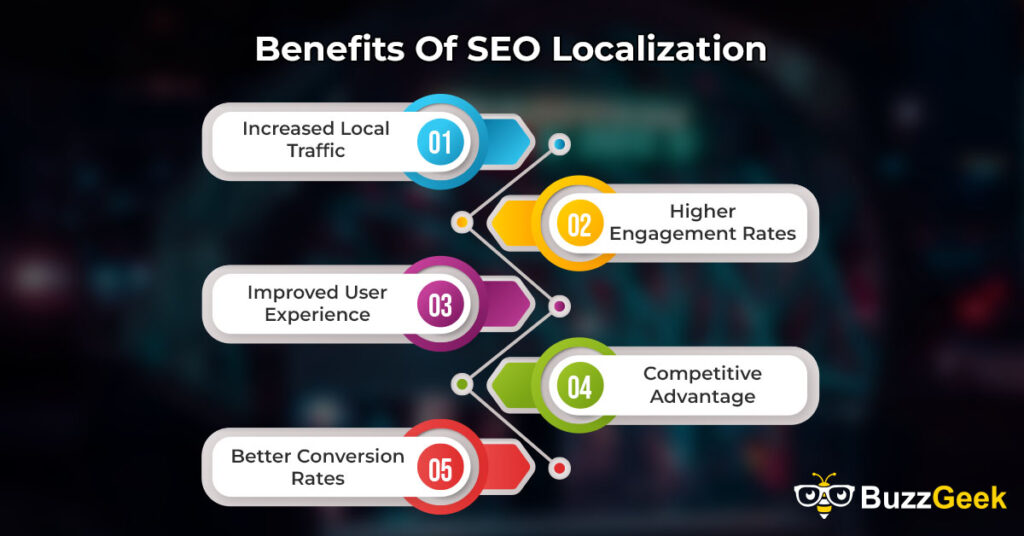
SEO localization offers many benefits for your business. It helps you reach and connect with local audiences more effectively. By making your website suitable for specific regions, you can see positive results.
Increased Local Traffic
SEO localization helps increase local traffic to your website. When your content is tailored to a specific region, it becomes easier for people in that area to find your site. This means more local visitors will come to your website, which can lead to more potential customers. Increased local traffic is one of the main advantages of SEO localization.
Higher Engagement Rates
Localized content leads to higher engagement rates. When people see content that matches their language and culture, they are more likely to interact with it.
This means they may spend more time on your site, read more articles, or explore your products. Higher engagement rates show that people are interested in what you offer. This is good for your business.
Improved User Experience
SEO localization improves the user experience on your website. When users find content in their own language that fits their culture, they feel more comfortable.
This makes it easier for them to navigate your site and find what they need. An improved user experience can lead to higher customer satisfaction and more repeat visits to your website.
Competitive Advantage
SEO localization gives you a competitive advantage. Many businesses do not take the time to localize their content, so by doing so, you can stand out in the market.
When your competitors are not localizing their content, you can attract more local customers. You can do it by offering a website that meets their specific needs. This can help you gain more customers and grow your business.
Better Conversion Rates
Localized content can lead to better conversion rates. When your website speaks directly to local users in their language and culture, it builds trust. This makes it more likely that visitors will become customers.
For example, if a product description is clear and uses local terms, people are more likely to make a purchase. Better conversion rates mean more sales and growth for your business.
Challenges In SEO Localization
SEO localization can be very helpful, but it also has some challenges. These challenges can make it harder to succeed, so it’s important to know what they are. Here are some of the main challenges you might face when implementing SEO localization.
Language Barriers
Language barriers are one of the biggest challenges in SEO localization. Translating content accurately is not always easy. Words or phrases in one language may not have a direct translation in another. This can lead to misunderstandings or awkward phrasing.
For example, idioms or slang in one language might not make sense in another. To overcome this, it’s important to work with good translators. Find someone who understands both the language and the local culture.
Cultural Differences
Cultural differences are another challenge in SEO localization. What works in one country might not work in another. For example, colors, symbols, or jokes that are popular in one place might be confusing or even offensive in another.
Understanding these differences is important. This helps make sure your content is appropriate and appealing to the local audience.
Technical Issues
Technical issues can also be a challenge. These include setting up hreflang tags and picking the right URL structure. It also includes ensuring your website loads fast in different regions. When these technical issues are not handled well, your website may not show up correctly in local searches. This can hurt your SEO efforts.
Maintaining Consistency
Maintaining consistency across all versions of your website can be difficult. It’s important to ensure that your brand message, tone, and style are consistent, even when the content is localized.
For example, your website should look and feel the same whether a user is in Japan or Brazil. Inconsistent content can confuse users and weaken your brand identity. To maintain consistency, it’s important to have clear guidelines and regular checks in place.
Tracking Performance
Tracking performance is crucial but challenging in SEO localization. You need to monitor how well your localized content is performing in each region. This can be difficult because different regions may use different metrics or tools.
For example, you may need to use different analytics tools to track performance in China compared to Europe. Without proper tracking, it’s hard to know if your SEO localization efforts are working. Regularly reviewing and adjusting your strategy based on performance data is key to success.
Best Practices For SEO Localization
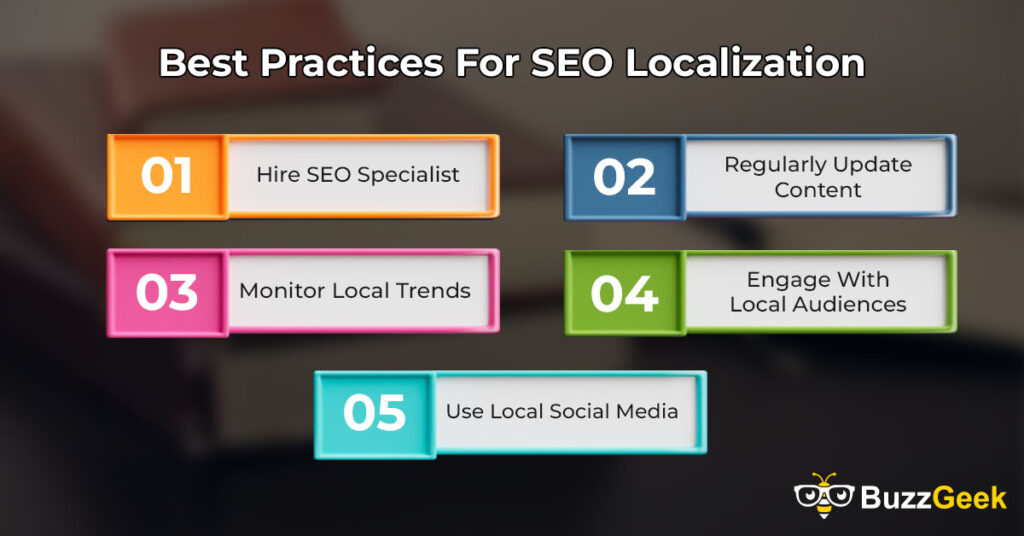
To get the most out of SEO localization, it’s important to follow best practices. These practices help ensure that your website performs well in different regions. They also help you connect better with local audiences. By following these steps, you can improve your chances of success in local markets. Here are some best practices for effective SEO localization.
Hire SEO Specialist
Hiring an SEO specialist with experience in localization is important. This expert can help you navigate the complexities of local SEO. For example, they can identify the right keywords for each region and ensure your content is optimized.
An SEO specialist also understands technical aspects like hreflang tags and local server setups. By having a specialist on your team, you can avoid common mistakes and improve your website’s performance in local searches.
Regularly Update Content
Regularly updating your content is key to maintaining good SEO localization. Search engines favor fresh content, and users appreciate up-to-date information. For example, you can update product descriptions to show new features or changes. It can keep your content relevant.
Regular updates also allow you to fix any issues that might arise, such as outdated links or translations. By keeping your content current, you can maintain your website’s visibility and relevance in local markets.
Monitor Local Trends
Monitoring local trends helps you stay ahead of the competition. Local trends can change quickly, and it’s important to adapt your content to reflect these changes. For example, if a new technology or popular topic emerges in a specific region, you should incorporate it into your content.
By staying in tune with local trends, you can make your website more appealing to local users. This can lead to increased traffic and better engagement.
Engage With Local Audiences
Engaging with local audiences is crucial for building trust and loyalty. This can be done through localized content, social media interactions, and customer support. For example, responding to customer inquiries in their local language can make them feel valued and understood.
Engaging with local audiences also helps you gather feedback, which can be used to improve your services. Building strong connections with local users can lead to higher conversion rates and long-term success.
Use Local Social Media
Using local social media platforms is an effective way to reach and engage with local audiences. Different regions may have different social media preferences. For example, while Facebook is popular in many countries, WeChat is more commonly used in China.
By using the right social media platforms, you can connect with users where they are most active. This helps you build a local presence and drive more traffic to your website.
FAQs
How Do Online Directories Help With SEO Localization?
Online directories help with SEO localization by listing your business on local websites. These directories include important details like your business name, address, and phone number. When your business is listed on here, search engines see it as more trustworthy and relevant for local searches.
How Do I Measure The Success Of SEO Localization?
You can measure the success of SEO localization by tracking key metrics. These include local search rankings, website traffic from specific regions, and conversion rates. Tools like Google Analytics can help you see where your visitors are coming from and how they interact with your site.
What Is The Impact Of Mobile Optimization On Local SEO?
Mobile optimization is very important for local SEO. Many people use their phones to search for local businesses. When your website is mobile-friendly, it loads quickly and is easy to use on a phone. It improves user experience and increases the chances of local customers finding and staying on your site.
What Are Long-Tail Keywords In Localization?
Long-tail keywords in localization are specific phrases that local users might search for. These keywords are longer and more detailed than regular keywords. For example, instead of just “pizza,” a long-tail keyword can be “best pizza delivery in Brooklyn.” It helps your website rank for more searches.
Can Small Businesses Benefit From SEO Localization?
Yes, small businesses can benefit a lot from SEO localization. It helps them reach more local customers by making their website easier to find in local search results. Even with a small budget, small businesses can compete with larger companies by targeting the specific local markets.
Conclusion: What Is SEO Localization?
In conclusion, SEO localization is important for reaching and connecting with local audiences. By adjusting your website content to fit the language and culture of specific regions, you can appear higher in local search results. This helps attract more local visitors and increases your success in different markets. SEO localization helps your business grow worldwide while staying strong locally.